
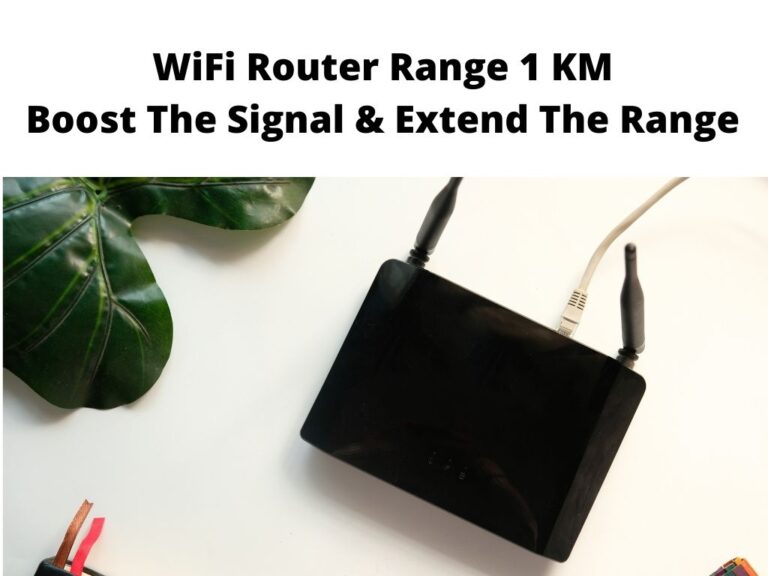
WiFi router range 1 km will be the emphasis of this write-up. Wi-Fi offers enhanced flexibility and versatility when compared to Ethernet networks.
This is because the range of a wireless network is enough that it reaches many offices and homes. In short, with a wireless network, it’s possible to extend the range of any network to one kilometer and even beyond with extra networking hardware.
Tools such as omnidirectional antennas, network repeaters, and added wireless routers can extend any wireless signal over a huge area so any device can be connected no matter where the device is around the home or office.
Table of Contents
How to Extend your Wi-Fi router range to 1 km?
- Step 1 First, you need to install a wireless repeater between the device and the wireless router which will be used to broadcast the signal. The function of the repeater is to recreate the signal the Wi-Fi produces.
With this, the signal strength won’t reduce that it will prevent any device from connecting to it. More than one repeater can be installed but the drawback is that the more repeater you install, the more the network will be reduced.
- Step 2 Next is to purchase and configure any omnidirectional antenna that will broadcast the signal emitted by the Wi-Fi over a large area.
The antenna functions by a cable connected to the router’s port. It is advisable to install the antenna outside because it still can work both indoors. The antenna signal is more reliable when compared to that provided by the repeater. In addition, it can allow any device up to two miles to get connected to the network.
- Step 3 You can as well make use of more than one wireless router to extend the signal range but this needs to be done with an Ethernet cable.
When the quantity of cable required to do the connection is available, connect the routes through their ports. Depending on the router broadcast range, you might need to connect up to three routers.
How to boost Wi-Fi router Signal?
1. Router Firmware Update
Before you start adjusting anything, it’s important to first update the router. As time goes on, the manufactures of any router continue to improve the operating system to improve its speed. How to upgrade your router will depend on the model and manufacturer.
However, the majority of modern routers have their update process built directly into the admin interface. So, to update implies hitting on the upgrade button.
For older models, you might be required to visit the manufactures website, download the firmware file then upload it to the admin interface. It might be a monotonous process but it will fix it.
2. Accomplish Best Router Placement
Wi-Fi distribution in the home might not be the same. This means that your Wi-Fi coverage will be determined by its location around your home.
So rather than placing your router far away, it should be kept at the center of the entire house so the signal can be distributed appropriately.
Also, the place needs to be an open area, away from any nearby obstruction or wall. Keeping it from any obstruction will also preventing it from overheating which can have a negative impact on the device as well as the signal being emitted.
3. Frequency determination
You need to cross-check your network admin interface to ensure its configured for optimum performance. If your router is dual-band, you’ll get a network because you can switch from 2.4 GHz to 5gGHz.
Not only that the latter offers a faster speed, but you also won’t experience any interference from other networks. This is because the frequency is not common.
4. Use a different Antenna
If the router you use has an internal antenna, it’s advisable to purchase an external one because it will increase its signal strength.
Getting an external antenna is not difficult because most manufacturers sell it separately. But preferably, it’s better to purchase omnidirectional antennas because they can send signals in all directions.
You can as well go for the directional antenna but be informed that it only sends signals to where it’s pointing.
The modern antenna comes with omnidirectional but if still want to purchase an external one, look for this sign; “high-gain”. That’s the difference.
5. Eliminate any Wireless Interference
Electronic gadgets like microwave, garage door openers, cordless phones, monitors, other wireless electronics can be an encumbrance blocking your router from function optimally especially if they use the same 2.4 GHz.
Yes, it’s not possible to eliminate them entirely but you can the interference they create by placing your router far away from them.
In Conclusion
Setting up a wireless home is easy now. Get a Wi-Fi router, connect the port to your broadband modem, and then to LAN ports.
Wireless G or 802.11g routers offer good Wi-Fi signal but if your activities entail transferring large files, constantly steaming videos then it’s better to purchase Wireless N or 802.11n router for higher data transfer speed.
Frequently Asked Questions
Does a Wi-Fi router have a maximum range?
A typical wireless indoor router of 802.11n with a stock antenna can cover 160 feet or 50 meters. However, an outdoor router that uses a directional antenna can cover many miles or kilometers.
What can I do to know my Wi-Fi router’s range?
You can make use of Airport Utility Application for iPad and iPhone to check the signal strength of your Wi-Fi on your phone.
Alternatively, you can use Wi-Fi Analyzer, especially for Android. These tools are easy to use. With them, you can easily get to know the strength of any wireless network.
Can Wi-Fi penetrate through walls?
Theoretically, Wi-Fi can pass through a wall including other obstacles. But in a real sense, some walls are thicker than others especially reinforced concrete walls.
This is the type that blocks signals for passing. However, materials like plywood, glass, wood, drywall can be penetrated by any Wi-Fi signal.
